
Photocatalysis & Piezocatalysis
Harnessing sunlight and mechanical energy for advanced catalysis
We develop advanced photocatalytic and piezocatalytic materials that harness sunlight and ambient mechanical energy to drive selective, sustainable chemical transformations. By tailoring defect structures, interfacial architectures and built-in polarization fields, we improve light utilization, charge separation and reaction selectivity for energy conversion and environmental applications.
Key Research Directions
-
Advanced Artificial Photosynthesis: Designing organic–inorganic interfaces and multi-junction architectures that extend light harvesting towards the near-infrared region for solar-driven hydrogen production.
-
Defect & Polarization Engineering: Tailoring crystal defects and polarization fields to regulate interfacial charge transport and enhance piezocatalytic activity.
-
Selective ROS Generation & H₂O₂ Synthesis: Developing controlled oxygen-activation pathways, including two-electron oxygen reduction, for selective production of hydrogen peroxide and other reactive oxygen species.
-
Environmental Remediation: Developing high-performance catalytic materials for the degradation of pharmaceutical contaminants, organic dyes and other persistent pollutants in aqueous environments.
Team

Prof Sai Kishore RAVI
Team Lead

Dian Zhang
PhD Student

Nur Karimah
PhD Student

Bonan Li
Research Assistant

Xiaowen Ruan
Postdoc

Jie Gao
PhD Student

Chunsheng Ding
Research Assistant

Weicheng Chen
Research Assistant
Major outcomes
-
Journal: Nature Communications (2026), Accepted
-
Authors: Ruan, X., Ding, C., Cai, H., Jiang, R*., Xu, M., Meng, D., Fang, G., Zhang, D., Wang, L., Cui, X*., Huang, H*., & Ravi, S. K*.

Figure: (d) Growth of zebrafish cultured in the different solution. (e) The zebrafish hatching. (f) Zebrafish swimming trajectory (g) distance and (h) speed in 20 min light from the darkness alternating. SMX Sulfamethoxazole solution, SMX-D Sulfamethoxazole solution after degradation.
-
Journal: Advanced Energy Materials (2026), e70895
-
Authors: Zhang, D., Ruan, X*., Wang, L., Cheng, B., Xu, M., Ding, C., Huang, H*., & Ravi, S. K*.
-
Link: https://advanced.onlinelibrary.wiley.com/doi/abs/10.1002/aenm.70895

Figure: (a) Schematic illustration comparing defect engineering, type II heterojunctions, and the proposed Pt/BCFO system in piezocatalytic hydrogen production field. (b) Schematic representation of the material design for Pt/BCFO. (c) Visualization of the piezo-induced carrier transport and the favorable H2O dissociation configuration in Pt/BCFO
-
Journal: Advanced Materials (2026), e22831
-
Authors: Ruan, X., Ding, C., Jiao, D*., Leng, J., Xu, M., Li, B., Yu, Z., Cui, X., Yu, J.C., Zhu, Y*., & Ravi, S. K*.
-
Link: https://advanced.onlinelibrary.wiley.com/doi/10.1002/adma.202522831

Figure: (f) Schematic diagram of a flow catalytic device for photocatalytic H2O2 production. (g) Photocatalytic H2O2 evolution rate of the Ga-ZvIS catalyst from Figure 5f. (h) Optical photographs of MO and RhB degradation by Fenton reaction using H2O2 produced by Ga-ZvIS from Figure f.
-
Journal: Advanced Science (2025), e2501037
-
Authors: Ruan, X., Meng, D., Xu, M., Fang, G., Ding, C., Leng, J., Wang, X., Ba, K., Zhang, H., Zhang, W., Xie, T., Jiang, Z., Dai, J*., Cui, X*., & Ravi, S. K*.
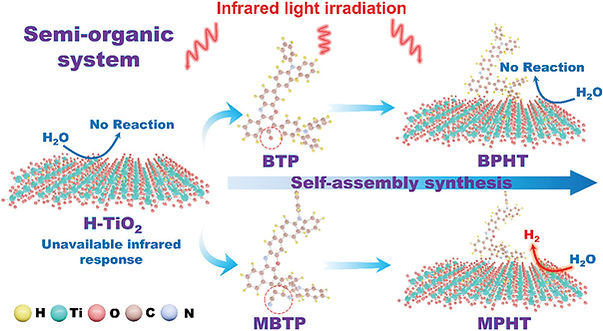
Figure: Schematic diagram of hydrogen evolution mechanism by semi-organic artificial photosynthetic system under near-infrared light irradiation.
-
Journal: Advanced Energy Materials (2026), e71114
-
Authors: Ding, C., Ruan, X*., Su, Q., Cai, H., Xu, M., Wang, L., Zhang, W., Huang, H., Ravi, S. K*., & Cui, X*.
-
Link: https://advanced.onlinelibrary.wiley.com/doi/abs/10.1002/aenm.71114

Figure: (a) Key limitations of conventional metal-based oxygen reduction pathways for H2O2 production. (b)-(d) Oxygen π* 2p orbital occupancy of •O2−, O2, and 1O2 and the corresponding trend in electron-binding capacity. Cation vacancy modulation (via alkaline etching) weakens metal–oxygen interactions, facilitating superoxide release and access to 1O2. (e) Comparison of *OOH adsorption behavior on pristine bismuth titanate (BTO) and Ti-vacancy-modulated BTO (Tv-BTO), showing strong *OOH adsorption and suppressed desorption on BTO versus weakened *OOH adsorption, enhanced desorption, and subsequent 1O2 -mediated H2O2 formation on Tv-BTO under piezo-catalytic conditions.
-
Journal: Advanced Materials (2023), 35(6), 2209141
-
Authors: Ruan, X., Huang, C., Cheng, H., Zhang, Z., Cui, Y., Li, Z., Xie, T., Ba, K., Zhang, H., Zhang, L., Zhao, X., Leng, J., Jin, S., Zhang, W., Zheng, W., Ravi, S. K*., Jiang, Z*., Cui, X*., & Yu, J.

Schematic Illustration of a) Z-scheme in natural photosynthesis, b) Z-scheme in an artificial photosynthetic system, c) S-scheme, d) twin S-scheme artificial photosynthetic system before and after contact, and under illumination. e) Schematic diagram of electrostatic self-assembly of material