
Plastic Recycling and Upcycling
Biohybrid and catalytic materials for circular plastic valorization
We develop biohybrid and catalytic material systems that complement established collection, sorting and mechanical recycling routes. Our research focuses on post-consumer and challenging plastic streams, creating selective pathways for feedstock conditioning, resource recovery and the conversion of plastic-derived resources into useful chemical, material and energy-relevant products. Through these approaches, we aim to support a more circular and resource-efficient plastics economy.
Key Research Directions
-
Decolourisation & Feedstock Conditioning: Developing semi-biological strategies to prepare diverse post-consumer plastic streams for downstream conversion and resource recovery, including approaches that address colour, composition, structure, and other factors affecting processability.
-
Selective Polymer Deconstruction: Creating catalytic and biohybrid platforms that enable controlled breakdown of plastic materials into recoverable, value-bearing resources.
-
Sustainable Resource Recovery: Exploring abiotic and biotic pathways to transform recovered plastic-derived resources into higher-value chemicals, functional materials, and fuels.
-
Circular Integration: Creating scalable technologies designed to integrate smoothly into existing industrial recycling ecosystems, moving from waste collection to closed-loop manufacturing.
Team

Prof Sai Kishore RAVI
Team Lead

Satyanarayana Reddy
Postdoc

Xiaowen Ruan
Postdoc

Lin Wang
PhD Student

Figure: Energy Architecture and Waste Management Dynamics in Modern Urban Systems. a-b) Energy framework of contemporary society benchmarked against the grid in representative cities in different climatic zones of China.
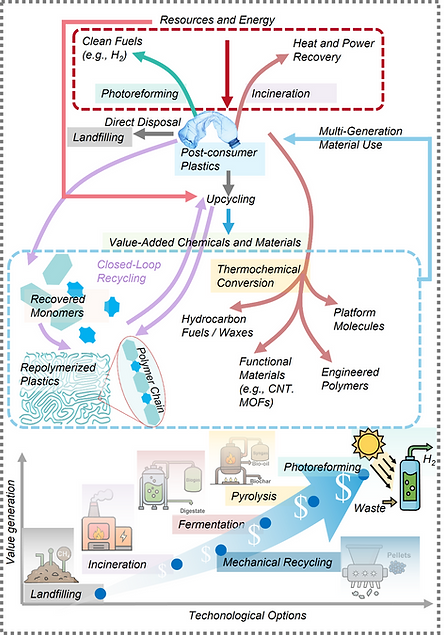

Figure (Left): Schematic of Waste Management and Valorization Pathways, showing how End-of-Life Materials can Proceed through Disposal, Energy Recovery, Recycling, or Conversion into Higher-Value Products.
Figure (Right): Closed-Loop Circular-Economy Model based on Photoreforming of Waste-Derived Feedstocks.
Outcomes
-
Filed Patent: Method For Processing Thermoplastic Polymers For Degradation; [PWG/PA/2312/3/2026 (HK-O)
-
The team awarded with HK Tech 300 Seed Fund for the REBIRTH PLASTICS (REcycling through Biocatalytic Innovation for Regenerative THermoPLASTICS) business proposal
Photoreforming and Photoelectroreforming of Waste-Derived Feedstocks for Solar-Driven Production of Fuels and Chemicals
-
Journal: Advanced materials (Accepted)
-
Authors: Chen, W., Luo, M., Tan, Y., Yan, L., Liao, T., Liu, W., Liu, F., Chen, Z., Yao, J., Liang, X., Fang, Y., Wang, S., Ke, Y., Suwardi, A.*, Tan, S. C.*, & Ravi, S. K.*


Figure (right): Architectural Paradigms in PEC System for Photoelectroreforming of Waste-Derived Feedstocks, encompassing Three Configurations: a-c) Photoanode/Cathode PEC Half-Cell System, d-e) Photocathode/Anode PEC Half-Cell System, and f-h) Photocathode/Photoanode Tandem PEC System.
Figure (left): Overview of Synthesis-Directed Photoreforming of Small Molecules.