Biohybrid Materials
Integrating biological systems and nanomaterials for sustainable energy and environmental technologies
We integrate biological components with functional nanomaterials to develop hybrid systems for solar-energy conversion, environmental applications and bioelectronic sensing. By interfacing photosynthetic assemblies, proteins and enzymes with semiconductors and catalytic materials, we combine biological selectivity and molecular functionality with the light-harvesting, charge-transport and catalytic capabilities of synthetic platforms.
Key Research Directions
-
Semi-Artificial Photosynthesis: Engineering bio–abiotic interfaces that couple photosynthetic components—such as thylakoids, photosynthetic proteins and pigments—with semiconductors and functional nanomaterials for solar-driven chemical conversion.
-
Bioelectrochemistry & Interfacial Charge Transport: Designing efficient electron-transfer pathways across biological and synthetic interfaces, including systems that use built-in potential gradients and responsive electrolytes to improve hybrid energy-conversion performance.
-
Photosynthetic Bioelectronics: Developing flexible pigment–protein and biohybrid devices for light-responsive sensing, touch perception, ultraviolet detection and self-powered electronic skins.
-
Green Fuel Generation: Developing photo(bio)catalytic pathways for water splitting, carbon dioxide conversion and the synthesis of solar fuels and value-added chemicals.
Team

Prof Sai Kishore RAVI
Team Lead

Satyanarayana Reddy
Postdoc

Lin Wang
PhD Student
Major outcomes
-
Journal: Advanced Materials (2018), 30(35), 1802290
-
Authors: Ravi, S. K., Wu, T., Udayagiri, V. S., Vu, X. M., Wang, Y., Jones, M. R., & Tan, S. C.

Construction of a multipixel sensor. a) Deposition of Au or b) ITO in nine pixels on PET substrates. c) Coverage of the Au-PET substrate protein/Q0-SCN blend within the boundary of a peripheral spacer. d) Sandwiching of the protein/Q0-SCN blend between the electrodes. e) Final device architecture with the nine Au pixels connected to separate terminals and the nine ITO pixels connected to a common terminal. f) Assessment of touch and tracking responses from the flexible multipixel sensor.
-
Journal: Advanced Materials (2018), 30(5), 1704073
-
Authors: Ravi, S. K., Ku, Z., Jones, M. R., & Tan, S. C*.

Figure: Properties and fabrication of photobioelectrochemical cells.
-
Journal: Advanced Energy Materials (2019), 9(35), 1901449
-
Authors: Ravi, S. K., Zhang, Y., Wang, Y., Nandakumar, D. K., Sun, W., Jones, M. R., & Tan, S. C*.

Schematic of a Bio-Schottky electrode. A metal/n-Si Schottky junction electrode is partially covered by a highly absorbing film of Rba. sphaeroides photosynthetic (PS) membranes containing RC–LH1 complexes. Electrons and holes generated as a result of charge separation in the RCs are shown in blue/cyan and electrons generated in the Schottky junction are shown in red/yellow. The Schottky electrode surface exhibits a lateral potential gradient between exposed and covered areas.
-
Journal: Advanced Energy Materials (2017), 7(7), 1601821
-
Authors: Ravi, S.K., Yu, Z., Swainsbury, D.J.K., Ouyang, J., Jones, M.R., & Tan, S.C*.

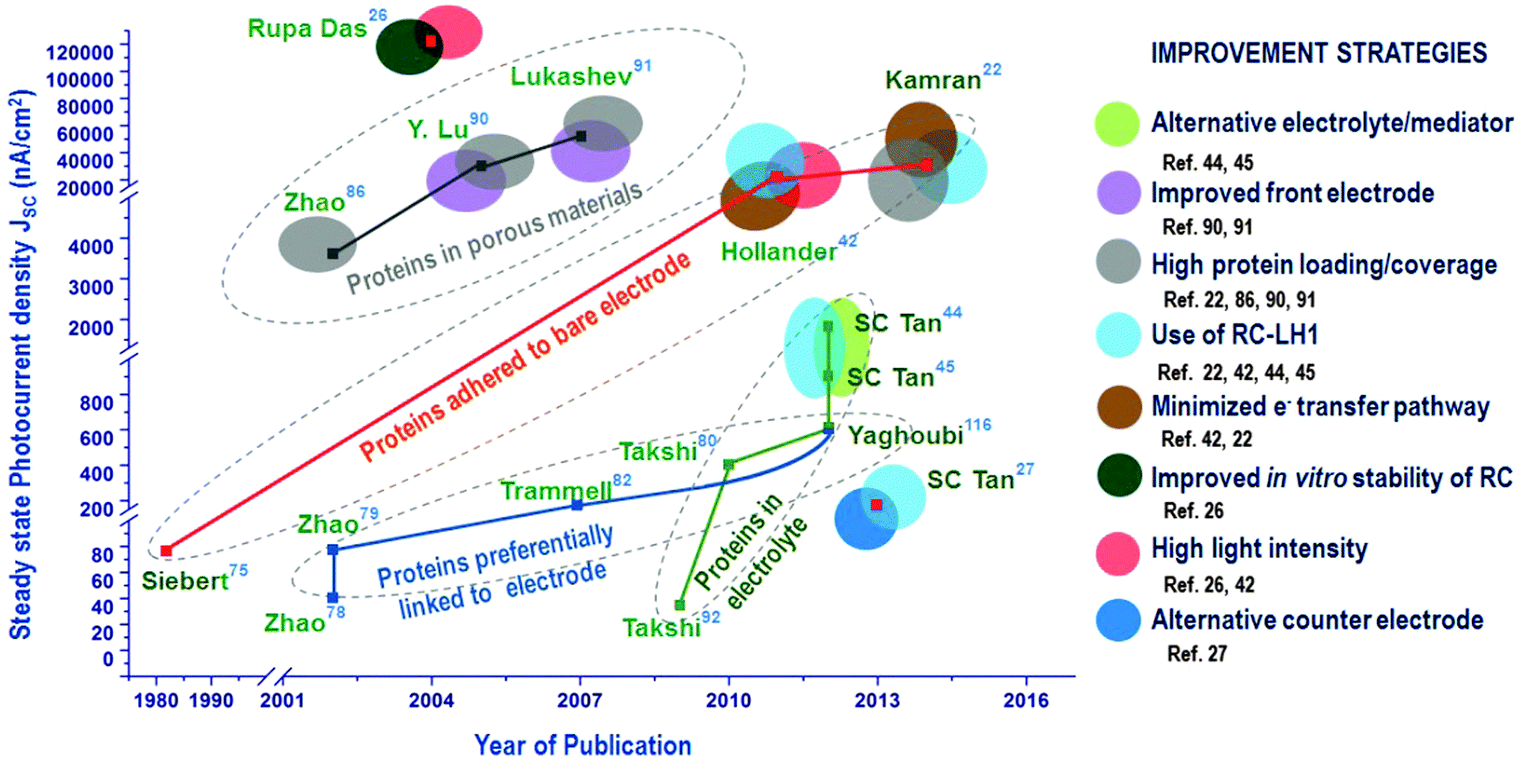
Progress and perspectives in exploiting photosynthetic biomolecules for solar energy harnessing
-
Journal: Energy & Environmental Science (2015), 8, 2551-2573
-
Authors: Ravi, S. K., & Tan, S. C*.